re: Active Recall
preface: I wrote this kind of freely during a break at work. my text adresses decline in literacy than methods of remembering, though I find them very related. It has not been proofread and definitely carries some traits of being written during a break at work
I recently read Herman's Active Recall-post about methods of remembering.
Many of the things there, and I assume also in the study referenced (I haven't read it yet) resonate really well with me. My main method of structuring information and understanding my own internal thoughts is also through writing; a big part of why I made this site in the first place, and why I try to write a note of what I'm doing and/or thinking of every day for my 10 months here in Brazil. The finishing sentiment really sticks out to me:
The interesting part is that I don't really read my notes or journal. The act of writing is the important bit.
In a nutshell: I write for you all, but I guess I also write for me.
...which is a very good re-wording of my entire approach to this website.
When I was writing my university exams in November & December 2025, I very much noticed how effective this method is at retaining and understanding information. This is somewhat of a cliche among writers (and especially amateur ones) but it was a very specific experience of how having to process and word something for yourself and to create your own examples, comparisons, and analogies makes you retain information.
One of the assignments was shockingly simple: read two articles, one chosen by the professor and one that you choose yourself which is related to but not on curriculum, and rewrite/summarize it with your own words1. Half a year later, I can still remember pretty much all the main points in those articles.
The first one is on "communicative musicality" by Ulla Holck (2008)2. First it defines the term (using 'musical elements' for communicating instead of performing, ie. how we talk to babies), then it talks about the importance of it especially with regards to babies and younger children, the relationship between the mother and child, what can happen if it's missing, and a little bit about communicative musicality in children with different communicative disorders. The other one is by Stephen Clift and is called Singing, Wellbeing, and Health (found in Music, Health, and Wellbeing). Clift talks about the current state of research on said topics, mostly criticizing it for being lacking or still in early stages, before talking about projects on a research center he is associated with. I could if I wanted to go into the details of course, but that would be out of scope of this text.
The one part where this method kind of fails, is remembering very specific details; flashcards is better for this. Ie. it's harder for me to remember the name of Clift's research center, and I had to look up the book that I found it in to find the name of the article. Same goes for Holck's first name. But for retaining vast amounts of the "important" information, this is fantastic.
With all of this in mind, I must say that I am very scared about current developments not only in academia but the wider world as well. In his text, Herman states that we've had the first decline in reading comprehension ever recorded - while this statement isn't backed up by an article in his text, it does very much coincide with what I hear from educators regardless of field and country, and also what I see myself as a student and educator.3
When I was writing this exam in the reading hall, a co-student of mine handed me their laptop asking if I could proof-read something for them.4 The laptop I got handed had a split-screen of MS Word and.... ChatGPT.... And I could see that a passage of text had just recently been copy-pasted, still highlighted in blue and everything.
I am frightened. I feel that we are approaching a functional illiteracy in society, where we can consume the words of two novels within a day but still not read nor understand any of it - and much less read an article or a book. When I open newspapers, I don't see paragraphs anymore. I see one or two sentences followed by a line break, even for dense and advanced topics such as this one from the Norwegian Broadcaster:
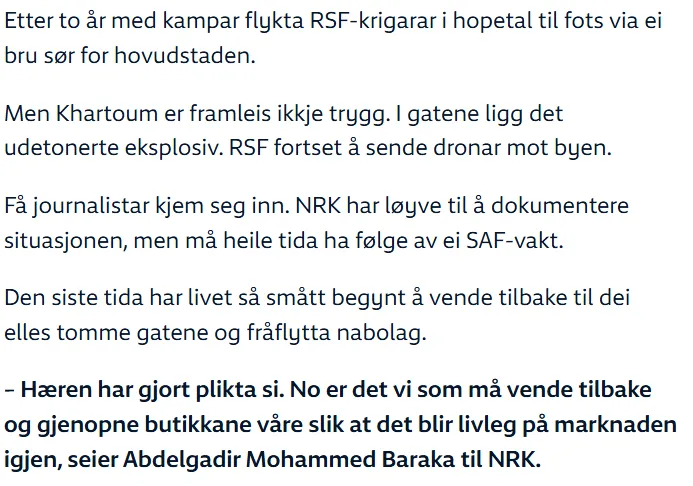
It feels as if people will not read something if it isn't the size of a tweet anymore. Even students. At a university. Taking up a loan of 160 000 NOK for a year.
I am sort of unable to begin to really comprehend, understand, or know how to relate to this situation. It scares me. And what scares me even more is how we seem to just have accepted it.
My university, NTNU, has made "their own AI" (wonder what's in the backend) so students can use it "safely"; we need to "embrace the future", it's "inevitable" anyways. People joke about brainrotting and doomscrolling as if it's nothing, and seem to take little-to-no action about it.5 Ffs, in one of our classes part of our obligatory assignments was answering a simple questionnaire going "What key points do you remember? What did you not understand? What do you want to learn more about?" regarding each of our classes after they were done. People didn't do it throughout the semester, and when speedily rushing it in the end, people couldn't remember what our classes were about.
Before I started university, I had a somewhat naive hope that this arena, the one where people go specifically to gather and process knowledge would be different. And most of all I wish that I couldn't feel that all of this, regardless of how much smaller of a scale, is also happening to me.
It's a constant struggle to stay in a "good place" so to speak. To be reading, to be writing, to not be brainrotting and doomscrolling. To be working to remember stuff, to be working to understand stuff, to learn, or to create something positive that you want to create.
To make the ending feel related to the top: I guess writing, free recall, active recall, whatever you want to call it is my current main tool against this. And I guess it is one of the things really keeping me from falling into despair.
Frankly speaking a little bit scared by how this is a university level assignment, but given my experiences with seeing other students being unable to read a full page without opening tiktok or needing an LLM to explain an assignment to them, I do kind of understand it...↩
https://www.researchgate.net/publication/259576941_Kommunikativ_musikalitet↩
Though it's worthing noting I'm veeery fresh as an educator and mostly work with children in primary school right now. I also only work through workshops for the time being; I wouldn't call myself a teacher.↩
The exam form was 1 week home exam, where you get handed the assignment (including new articles to read or field work to get through) before handing in at the end, making stuff like this possible. We were semi-encouraged to help eachother out with finding ideas and with stuff like this, though writing for someone else was forbidden. Surely didn't stop it for many people though, especially not using LLMs....↩
Here I will acknowledge that this at least points to a normalized understanding of the situation, even if shallow. I also want to highlight that I acknowledge that most people understand and differentiate between the states "I want to go learn something" and "I want to zombie for just a bit". Obviously, scrolling feels fucking good, it's psychology weaponized at scale to make you feel that wa- okay I'm getting off topic.↩